Water-resistant micro fiber, ripstop nylon and 600D TXP
Colours
Black/Grey
About this bag
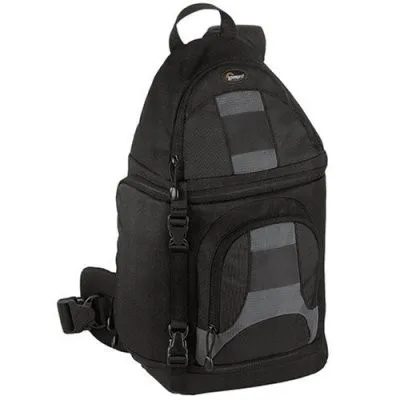
Perfect for photojournalists, the SlingShot 300 AW uses a unique sling design to go from "carry mode" to "ready mode" in just seconds. Carried comfortably on the back, it easily rotates to the front so you can get to your camera quickly. The SlingShot 300 AW holds an Pro SLR with zoom lens attached 5-6 extra lenses, cables and accessories and has a full access lid to make loading it a snap. This feature-rich bag also includes a built-in memory card pouch, micro fiber LCD cloth and two generous organizer pockets. It's certain to surprise even the most demanding photojournalists.
What fits inside
Pro SLR with attached 70-200 mm f/2.8 lens; 5-6 extra lenses or flash unit
Quality bag and dust free, But when heavy used and loaded the lining sticks come in between the zipper
What works
Instand shoot with the possibility to access three lenses (one mounted and one on each site through the Velcro strips
Room for improvement
Velcro strips are getting tired and are not that sticky any more.
In the bag
Canon EOS 40D with Grip and mounted Canon EF 24-105mm f/4L IS USMTokina 12-24mm f/4Canon EF 70-300mm f/4.5-5.6 IS USMCanon 430EX SpeedliteCanon 400D Digital Rebel XTi
Canon EF 50mm f/1.8canon 40d
The Slingshot 300 is another sling-type bag that is a little larger than the Velocity, but it is a moulded shape. There is a little bit of give if something is a tad too big. Unlike the Velocity this bag has 2 compartments as opposed to a large compartment and a flap in the front. There are little extras in the Slingshot like a built in lens cleaner, too may places where CF cards can live and 2 mesh storage areas in the top compartment. Even the area where the all weather cover is contained could be used to carry a magazine or something thin. Lenses with the hoods, except for the 16-35L, also fit into this bag and the 70-200 will fit mounted and unmounted if you do some planning with the dividers. I have mine where the flash is stored under my 70-200 on one side and my other lenses on the other. The 20D with a lens mounted is in the middle with a spare compartment relatively empty with only my
This bag when slung across the chest and the pack in the back also sits right in the middle like the Velocity and is very easy to bring forward and retrieve your equipment. Unlike the Velocity it is very comfortable when only slung on one side. I might add that it is the left hand side that feels more comfortable. Finally, something made for us southpaws!
I think that I like this bag a little better that my Velocity because of the fact that none of the lenses have to be stacked and are easier to get to. Even thought the top compartment now is the home for the hood for the 16-35, warming cards, batteries and the flash bracket it can still store more items such as a small snack for the long shooting days. Overall a great alternative if you need something small to carry a decent amount of equipment.
What works
-Lots of compartments -Sits upright when set down -Comfortable if just slung over one shoulder (left side) -Quick visibility of equipment
Room for improvement
-One of the slip-lock straps is on the bottom of the bag? -Seems a little too rigid (not used to it yet -Small carry handle on the top
In the bag
Canon EOS 20D with grip
Canon EF 16-35mm f/2.8L USM with hood
Canon EF 24-70mm f/2.8L USM with hood
Canon EF 70-200 f/2.8L IS USM with hood
Canon EF 50mm f/1.8Canon EF 2X Extender
2 Delkin AA battery cases (holds 8 AA each)
2 BP511 Batteries
420EX flash
Canon Off Camera Shoe Cord 2
Large Rocket Blower
Vortex Media Warm Cards
Gepe Compact Flash Holder for 4 cards
Newton Di100FR2 folding flash bracket
Hoodman HoodLoupe Professional
Neck Strap
canon 20d
left column (top to bottom)
Charger + 2 Batteries
Filter Packs
Canon 580EX Speedlite
middle column
Assorted Cables
Canon EF 28-135mm f/3.5-5.6 IS USMCanon EOS 5D
right column
Lightsphere II C4 + Stofen Omni Bounce
canon 5d
I originally had the Slingshot 200AW and thought it was the ideal bag for the type if environments I found myself in. Even after getting a 70-200 f/2.8L IS lens and 1.4 TC, I could still have the 30D attached in the 200AW. However putting a BG-E2 grip on the 30D was just too much. I had to have the 70-200+TC separate from the body. I could get everything in the 200AW but it was a tight fit and required careful arranging of all the pieces. It detracted from the easy access that first drew me to that bag.
I think the 300AW now meets my requirements with the current lineup of equipment I currently have. While I don't want to carry any more weight, I did want to get back the flexibility and easy access that I originally had with the 200AW.
In comparison to the 200AW, the 300AW is a wider/deeper version of the 200AW. The height is exactly the same. To be clear, that's the vertical height when worn on your back (shoulder to hip). When the bags are side-by-side, the 300AW looks so much larger. However, when worn on my back, I don't notice the difference at all. This might be a different story for people shorter than I am (~6'0").
One nice surprise was an additional mesh pocket on the inside of the flap to the top compartment. The 200AW has a strap that is attached to the lower right corner of the bag and can be snapped to a chest buckle on the main shoulder strap. The 300AW has replaced this with a well-padded waist strap. All the other features are exactly the same as the 200AW.
With my usual complement of equipment loaded in the 300AW, the total comes to about 16 pounds. If I cinch up the waist belt, a fair amount of the load is taken off the shoulder strap. After a 45 minute walk it was still comfortable. My feeling is that I could wear it this way for quite a while longer. Without the waist strap on, there is definitely more pressure on the shoulder strap.
I would not want to add any more weight regardless of the Slingshot model. In fact I am rethinking what combinations of equipment I would actually want to carry around for different events.
If I was going on an extended hike or need to carry more equipment then I would move to a regular backpack style bag. If I just needed the camera body plus 1 or 2 smaller lens then I would look for a waist belt setup. For general shooting, the 300AW provides a reasonable balance between comfort and carrying capacity.
I'm reserving final judgement in regards to the waist strap. On one hand, it is functional and aids in distributing the weight. On the other hand it is permanently attached and may get in the way in situations where I need to repeatedly swing the bag around for access.
The worst thing I can say about the 300AW is that it makes it too tempting to load it up with even more equipment. Overall I am very pleased with the "upgrade" from the 200AW to the 300AW. For my equipment load, style and type of photography, I find the Slingshot series it to be the ideal combination.
What works
Well made, easily to re-configure, comfortable, easy access to equipment, holds 30D+grip+TC+70-200
Room for improvement
Large size makes it tempting to overload, waist strap can get in the way
In the bag
Canon EOS 30D with BG-E2 grip
Canon EF 70-200 f/2.8L IS USMCanon EF-S 17-85mm f/4-5.6 IS USMCanon EF 50mm f/1.8Canon EF 85 mm f/1.8 USMCanon 430EX Speedlite, Hyperdrive hd80
canon 30d
I originally considered the Slingshot 200 AW to carry a lightweight travel setup. When I heard about the Slingshot 300 AW being released I decided to wait for one so I could try it with my 1D 'main' setup. I managed to get hold of one of the 'early' release SS 300s that Lowepro sent to B&H.
The bag arrived wrapped in a large Lowepro marked plastic bag with all the tags and packing material. Workmanship is fairly typical for Lowepro, however my initial impression was that it was not quite as well finished as my older Lowepros (Orion AW, Spec. 85 AW, Trim Trekker, and Omni Trekker). This bag had more of a shiny look to it, whereas my older bags 'feel' more rugged. This isn't necessarily a knock against this bag-just a note of the difference in 'feel'. Other than that, I have no issues with the build quality.
The bag offers a full waist belt with large support 'wings' on each side. Depending on your view, this may or may not be a good thing. In my opinion NO waist belt should ever be permanently attached to any bag. I'll even go one step further-NO strap of any kind should be permanently attached to a bag. This is one reason why I shied away from the Tamrac Velocity Series. They have permanently attached straps. (In defense of the Tamrac Velocity bags though, the waist strap can be tucked into a pouch in the back of the bag. No such pouch on the Lowepro Slingshots, all that waist belt remains exposed). I prefer to use a belt of my choosing, and have the option of using it only when I want to. Otherwise they just get in the way. And with such a large belt as used on the Slingshot 300 AW, it really does detract from the comfort level and ease of carry. The main 'strap' that goes over your shoulder is well padded and curved to follow the contours of your back. This strap is also permanently attached at the top of the bag, with an adjustable buckle arrangement at the bottom. There is plenty of slack on all of the straps to fit any sized person I could imagine. One that I really miss on this bag is any type of back pack harness attachment points or a way to integrate this bag into the Street & Field line of belts and accessories. Bascially, with this bag you have to "take it or leave it". Oh-almost forgot, there are four sliplock attachment points on the bag (two on the waist belt and two on the front of the main bag).
The three pockets (top-main, front, inner CF card pocket) are well thought out and sufficient for the task of holding the small essentials such as extra batteries, CF cards, and cleaning gear. They will also hold a lens hood or two if needed.
The main compartment will easily carry a Canon 1 Series or Nikon D2? sized camera (or any of the "semi-pro" bodies like the Nikon D200 or Canon EOS 30D with a grip installed) with a Canon EF 70-200 f/2.8L IS USM lens mounted. I had no trouble putting my 1D with a Canon EF 300mm F/4 L IS Lens attached in it, and could probably have fit my Sigma Zoom Telephoto 100-300mm f/4 EX DG IF HSM in there as well. I was able to put my Sigma 120-300mm f/2.8 EX in it, but it was not mounted on a body. The rest of the compartments are pretty straight forward hook and loop adjustable dividers. One thing to note is that while there are 6-7 'compartments, I found it impossible to put more than four lenses and the 300mm prime in them. This was because I had the hoods on them reversed, and that takes up a lot of room. If you use and carry hoods for all of your lenses like I do, this may impact you as well.
As of this writing I haven't decided whether to hang onto this bag or not, so I haven't 'field tested' it beyond my living room. It does seem comfortable, at least for the few minutes I've had it on. Something to consider if you are short in stature like me (I'm 5ft. 6 in.), is that the bag will ride best if you wear it 'high and tight' on your back. Not really a problem, except that when you swing it around to the front position it will be at chest level which is pretty high for accessing your gear.
Right now, for me, the jury is still out on this bag and whether or not it truly offers any advantage over Lowepro's 'regular' shoulder bags like the Stealth Reporter Series bags...
What works
Concept, design, and workmanship. I like the fact that it will hold a 1 Series body.
Room for improvement
Has a 'bulky' feel to it. Permanently attached straps are a bad idea, No 'back pack' harness option.
In the bag
Canon EOS 1D Mk I
Canon EF 300mm f/4 IS USM(mounted)
Canon EF 135mm f/2L USMCanon EF 100mm F/2.8 USM Macro Lens
Canon EF 28-135mm f/3.5-5.6 IS USMCanon EF-S 10-22mm f/3.5-4.5 USM
(2)NP-E3 batteries
Canon 580EX Speedlite (in case).
Note: all hoods except for the 10-22 hood are reverse mounted on lenses.
canon 1d
This bag holds two cameras with attached lenses ready to shoot, and can still be worn comfortably on the back. The interior can be modified easily. The 70-200mm/2.8 can be attached to either D300 or D80, a reversed lens hood will fit the compartment too (not shown).
In the bag
Nikon D80 w/ Nikon 70-200mm F/2.8G ED-IF AF-S VRNikon D300 w/ Nikon 18-200mm VR F/3.5-5.6G IF-EDNikon 35mm AF f/2Sigma 10-20mm f/4-5.6DNikon 85mm f/1.8Kenko Pro 300 x2 TCNikon SB-600 Strobe
Batteries, Accessories etc.
Price paid: 90000 KRW (=66 Euros) in Seoul
nikon d80
This bag holds two cameras with attached lenses ready to shoot, and can still be worn comfortably on the back. The interior can be modified easily. The 70-200mm/2.8 can be attached to either D300 or D80, a reversed lens hood will fit the compartment too (not shown).
In the bag
Nikon D80 w/ Nikon 70-200mm F/2.8G ED-IF AF-S VRNikon D300 w/ Nikon 18-200mm VR F/3.5-5.6G IF-EDNikon 35mm AF f/2Sigma 10-20mm f/4-5.6DNikon 85mm f/1.8Kenko Pro 300 x2 TCNikon SB-600 Strobe
Batteries, Accessories etc.
Price paid: 90000 KRW (=66 Euros) in Seoul
nikon d80
Empty it feels very comfortable and can be made to sit very low on the back. Full, well full by my current standards it weighs in at about 3.5 - 4kg. That includes the D200 and grip, the 18-70, the 70-200, the TC 1.7, two spare batteries, blower, power cord, USB cable, battery charger, manual, sunscreen, high vis vest and so on. Even in this configuration it still feels comfortable, I can see that the waist belt will be used when carrying it for extended periods fully loaded, however I don't see this happening that often as I usually have the camera out.
The top section is surprisingly roomy. There is enough room to stick a couple of flash units, a spare camera body (no lens attached) or a few munchies for a long day shooting. The later being what I will use it for in addition to the sunscreen, rain poncho and other items already in there.
The front section expands a little, but those familiar with any Lowepro backpack will recognise all the little areas in here. Space for the manual and other special resources, business cards, a pen and so on. As I mentioned earlier the main section is quite large. There is room for up to a pro body with 70-200f2.8 attached and six additional lenses! All this with the usual Lowepro movable velcro dividers!
Currently I have this set up to hold the D200 with grip and 70-200 f2.8 attached, the 18-70 kit lens, spare batteries, charger, TC 1.7 and a few other goodies. For those wondering, adding the TC 1.7 to this will still fit in, JUST. It is a squeeze and the bag is not really designed for the additional strain it will place on zippers, but it will fit.
By far the biggest bonus to this bag and the Slingshot series is the access panel or side panel. With the bag slung over the shoulder you can easily swing it around to access this panel, and from within you can draw out the camera ready to go. All without taking the bag off of your back! This is the main reason I bought it, to be able to put the camera away easily.
Incorporated into the top of the access panel is a CF card holder pouch, this is another nice little option for those that want easy access to put them away and out of pockets.
While I have not field trialled the bag yet, first impressions are that it will do the job I require. It will be comfortable to carry on my back / shoulder and allow easy access to the kit I readily need when shooting. The biggest drawback for some people will be the fact that there is no where to attach a tripod. This doesn't worry me too much as my primary use is not hiking but walking around a motor sport track. The usual Lowepro attachments are available and rigging up a monopod attachment will be very easy (when I buy one that is).
I would also like each of the zippers on the top and front sections to be double zippers rather than a single as I like this feature more. This is just a niggle though.
Overall I am impressed with the design of the bag and its features. There is a AW cover included with the bag, although I have not shown it, stores away in a dedicated velcro closed pouch at the back. Not sure how weatherproof it will be as it seems to be the usual spray jacket type of material, nothing scotch guard waterproofing can't fix.
What works
Ease of use in the field, Able to hold a pro-size body with 70-200mm f2.8 attached. Side panel access to camera without removing from your back.
Room for improvement
Only single zippers on the top and front sections.
The Slingshot 300 is another sling-type bag that is a little larger than the Velocity, but it is a moulded shape. There is a little bit of give if something is a tad too big. Unlike the Velocity this bag has 2 compartments as opposed to a large compartment and a flap in the front. There are little extras in the Slingshot like a built in lens cleaner, too may places where CF cards can live and 2 mesh storage areas in the top compartment. Even the area where the all weather cover is contained could be used to carry a magazine or something thin. Lenses with the hoods, except for the 16-35L, also fit into this bag and the 70-200 will fit mounted and unmounted if you do some planning with the dividers. I have mine where the flash is stored under my 70-200 on one side and my other lenses on the other. The 20D with a lens mounted is in the middle with a spare compartment relatively empty with only my
This bag when slung across the chest and the pack in the back also sits right in the middle like the Velocity and is very easy to bring forward and retrieve your equipment. Unlike the Velocity it is very comfortable when only slung on one side. I might add that it is the left hand side that feels more comfortable. Finally, something made for us southpaws!
I think that I like this bag a little better that my Velocity because of the fact that none of the lenses have to be stacked and are easier to get to. Even thought the top compartment now is the home for the hood for the 16-35, warming cards, batteries and the flash bracket it can still store more items such as a small snack for the long shooting days. Overall a great alternative if you need something small to carry a decent amount of equipment.
Now that I have all three of these bags I still can't decide which one I lile the most. I think that I will be getting rid of my Computrekker consideing I have a Pelican case that I can use to store my other equipment I'm not using. I like the Adventure 9 for all the extras that it can carry, the Slingshot because it's easy to get to the stuff that you need and the Velocity for the fact that it's very adaptable. I might end up taking 2 of the three bags when I go on my Italy trip..... So much for traveling light! Overall I've been gravitating towards the Slingshot for my daily carry, but I haven't been out and about with the Adventure 9 yet. Maybe I'll post more info when I do take it out more.
What works
-Lots of compartments -Sits up
Room for improvement
One of the slip-lock straps is
In the bag
Canon EOS 20D with grip
Canon EF 16-35mm f/2.8L USM with hood
Canon EF 24-70mm f/2.8L USM with hood
Canon EF 70-200 f/2.8L IS USM with hood
Canon EF 50mm f/1.8Canon EF 2X Extender
2 Delkin AA battery cases (holds 8 AA each)
2 BP511 Batteries
420EX flash
Canon Off Camera Shoe Cord 2
Large Rocket Blower
Vortex Media Warm Cards
Gepe Compact Flash Holder for 4 cards
Newton Di100FR2 folding flash bracket
Hoodman HoodLoupe Professional
Neck Strap
canon 20d
I was looking for a bag that was less bulky than a backpack, yet had pretty decent protection. Having just made the jump over to Canon, my current setup is very small and basic. However, I wanted a bag that would be able to carry my 5D with a mounted 28-300mm (future upgrade) and a few other gadgets needed for work.
The bag has 2 major compartments along with 2 smaller pouches. The main compartment has 7 user adjustable partitions (2 large, 5 small). The middle compartment has enough space to pack the camera left to right or up and down, whichever floats your boat. With the bag opened up, there's enough room to be able to drop a 580EX vertically.
In the bag
Charger + 2 Batteries
Filter Packs
Canon 580EX Speedlite
middle column
Assorted Cables
Canon EF 28-135mm f/3.5-5.6 IS USMCanon EOS 5D
right column
Lightsphere II C4 + Stofen Omni Bounce
canon 5d
I originally had the Slingshot 200AW and thought it was the ideal bag for the type if environments I found myself in. Even after getting a 70-200 f/2.8L IS lens and 1.4 TC, I could still have the 30D attached in the 200AW. However putting a BG-E2 grip on the 30D was just too much. I had to have the 70-200+TC separate from the body. I could get everything in the 200AW but it was a tight fit and required careful arranging of all the pieces. It detracted from the easy access that first drew me to that bag.
I think the 300AW now meets my requirements with the current lineup of equipment I currently have. While I don't want to carry any more weight, I did want to get back the flexibility and easy access that I originally had with the 200AW.
In comparison to the 200AW, the 300AW is a wider/deeper version of the 200AW. The height is exactly the same. To be clear, that's the vertical height when worn on your back (shoulder to hip). When the bags are side-by-side, the 300AW looks so much larger. However, when worn on my back, I don't notice the difference at all. This might be a different story for people shorter than I am (~6'0").
One nice surprise was an additional mesh pocket on the inside of the flap to the top compartment. The 200AW has a strap that is attached to the lower right corner of the bag and can be snapped to a chest buckle on the main shoulder strap. The 300AW has replaced this with a well-padded waist strap. All the other features are exactly the same as the 200AW.
With my usual complement of equipment loaded in the 300AW, the total comes to about 16 pounds. If I cinch up the waist belt, a fair amount of the load is taken off the shoulder strap. After a 45 minute walk it was still comfortable. My feeling is that I could wear it this way for quite a while longer. Without the waist strap on, there is definitely more pressure on the shoulder strap.
I would not want to add any more weight regardless of the Slingshot model. In fact I am rethinking what combinations of equipment I would actually want to carry around for different events.
If I was going on an extended hike or need to carry more equipment then I would move to a regular backpack style bag. If I just needed the camera body plus 1 or 2 smaller lens then I would look for a waist belt setup. For general shooting, the 300AW provides a reasonable balance between comfort and carrying capacity.
I'm reserving final judgement in regards to the waist strap. On one hand, it is functional and aids in distributing the weight. On the other hand it is permanently attached and may get in the way in situations where I need to repeatedly swing the bag around for access.
The worst thing I can say about the 300AW is that it makes it too tempting to load it up with even more equipment. Overall I am very pleased with the "upgrade" from the 200AW to the 300AW. For my equipment load, style and type of photography, I find the Slingshot series it to be the ideal combination.
What works
Well made, easily to re-confi
Room for improvement
Large size makes it tempting
In the bag
Canon EOS 30D with BG-E2 grip
Canon EF 70-200 f/2.8L IS USMCanon EF-S 17-85mm f/4-5.6 IS USMCanon EF 50mm f/1.8Canon EF 85 mm f/1.8 USMCanon 430EX Speedlite, Hyperdrive hd80
canon 30d
I originally considered the Slingshot 200 AW to carry a lightweight travel setup. When I heard about the Slingshot 300 AW being released I decided to wait for one so I could try it with my 1D 'main' setup. I managed to get hold of one of the 'early' release SS 300s that Lowepro sent to B&H.
The bag arrived wrapped in a large Lowepro marked plastic bag with all the tags and packing material. Workmanship is fairly typical for Lowepro, however my initial impression was that it was not quite as well finished as my older Lowepros (Orion AW, Spec. 85 AW, Trim Trekker, and Omni Trekker). This bag had more of a shiny look to it, whereas my older bags 'feel' more rugged. This isn't necessarily a knock against this bag-just a note of the difference in 'feel'. Other than that, I have no issues with the build quality.
The bag offers a full waist belt with large support 'wings' on each side. Depending on your view, this may or may not be a good thing. In my opinion NO waist belt should ever be permanently attached to any bag. I'll even go one step further-NO strap of any kind should be permanently attached to a bag. This is one reason why I shied away from the Tamrac Velocity Series. They have permanently attached straps. (In defense of the Tamrac Velocity bags though, the waist strap can be tucked into a pouch in the back of the bag. No such pouch on the Lowepro Slingshots, all that waist belt remains exposed). I prefer to use a belt of my choosing, and have the option of using it only when I want to. Otherwise they just get in the way. And with such a large belt as used on the Slingshot 300 AW, it really does detract from the comfort level and ease of carry. The main 'strap' that goes over your shoulder is well padded and curved to follow the contours of your back. This strap is also permanently attached at the top of the bag, with an adjustable buckle arrangement at the bottom. There is plenty of slack on all of the straps to fit any sized person I could imagine. One that I really miss on this bag is any type of back pack harness attachment points or a way to integrate this bag into the Street & Field line of belts and accessories. Bascially, with this bag you have to "take it or leave it". Oh-almost forgot, there are four sliplock attachment points on the bag (two on the waist belt and two on the front of the main bag).
The three pockets (top-main, front, inner CF card pocket) are well thought out and sufficient for the task of holding the small essentials such as extra batteries, CF cards, and cleaning gear. They will also hold a lens hood or two if needed.
The main compartment will easily carry a Canon 1 Series or Nikon D2? sized camera (or any of the "semi-pro" bodies like the Nikon D200 or Canon EOS 30D with a grip installed) with a Canon EF 70-200 f/2.8L IS USM lens mounted. I had no trouble putting my 1D with a Canon EF 300mm F/4 L IS Lens attached in it, and could probably have fit my Sigma Zoom Telephoto 100-300mm f/4 EX DG IF HSM in there as well. I was able to put my Sigma 120-300mm f/2.8 EX in it, but it was not mounted on a body. The rest of the compartments are pretty straight forward hook and loop adjustable dividers. One thing to note is that while there are 6-7 'compartments, I found it impossible to put more than four lenses and the 300mm prime in them. This was because I had the hoods on them reversed, and that takes up a lot of room. If you use and carry hoods for all of your lenses like I do, this may impact you as well.
As of this writing I haven't decided whether to hang onto this bag or not, so I haven't 'field tested' it beyond my living room. It does seem comfortable, at least for the few minutes I've had it on. Something to consider if you are short in stature like me (I'm 5ft. 6 in.), is that the bag will ride best if you wear it 'high and tight' on your back. Not really a problem, except that when you swing it around to the front position it will be at chest level which is pretty high for accessing your gear.
Right now, for me, the jury is still out on this bag and whether or not it truly offers any advantage over Lowepro's 'regular' shoulder bags like the Stealth Reporter Series bags...
What works
Concept, design, and workmansh
Room for improvement
Has a 'bulky' feel to it. Per
In the bag
Canon EOS 1D Mk I
Canon EF 300mm f/4 IS USM(mounted)
Canon EF 135mm f/2L USMCanon EF 100mm F/2.8 USM Macro Lens
Canon EF 28-135mm f/3.5-5.6 IS USMCanon EF-S 10-22mm f/3.5-4.5 USM
(2)NP-E3 batteries
Canon 580EX Speedlite (in case).
Note: all hoods except for the 10-22 hood are reverse mounted on lenses.
canon 1d